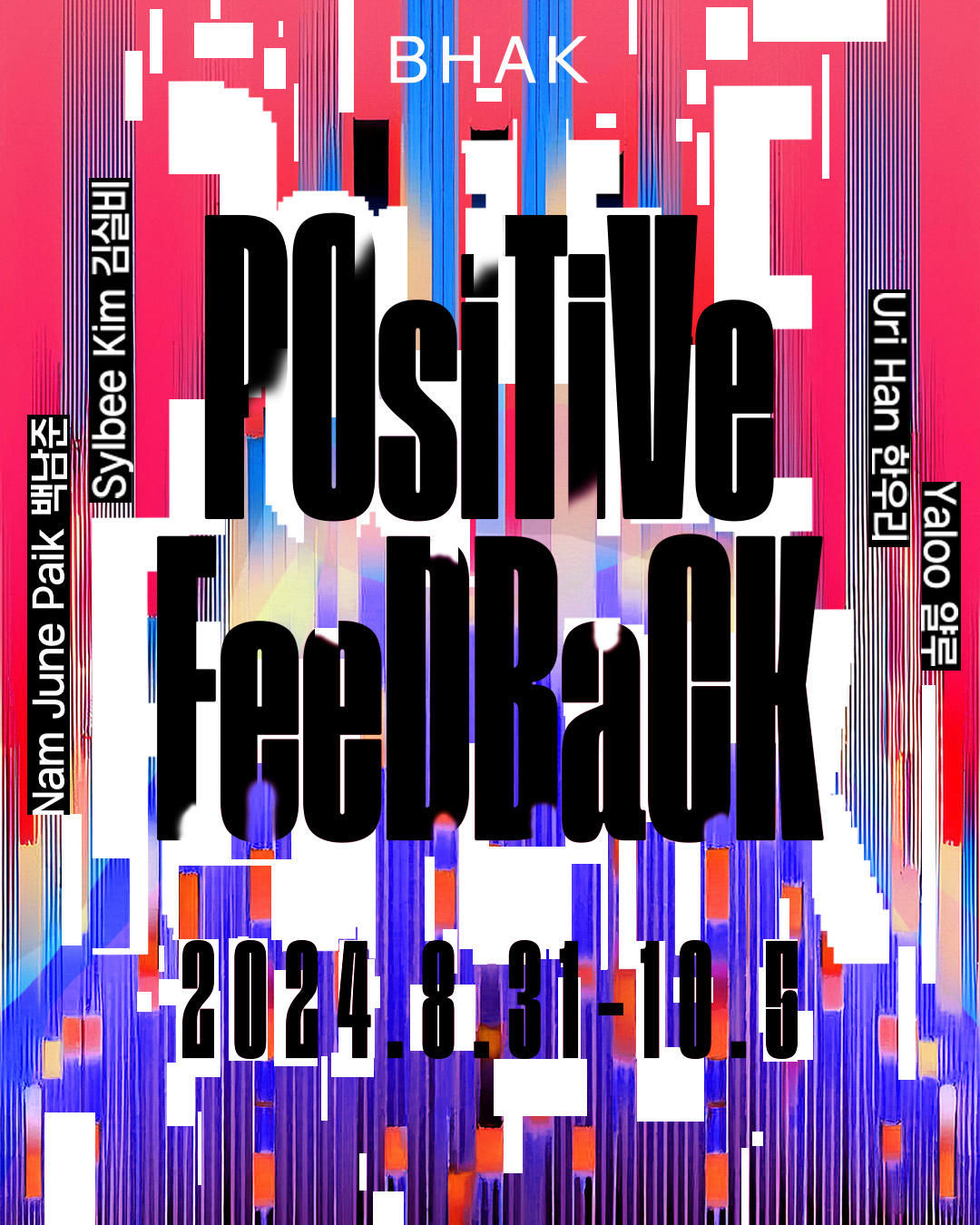
We live in an era where diverse temporalities coexist. Modern individuals traverse time and space without constraints using smartphones and the internet, communicating with various people and accessing vast amounts of information. This contemporary sense of time moves beyond the linear structure of past, present, and future, weaving in multiple directions like a tapestry, repeatedly meeting and parting. This exhibition explores the works of the renowned artist Nam June Paik, who delved deeply into the complex and subtle nature of time, along with the next generation of artists, Sylbee Kim, Yaloo, and Han Uri, who continue his legacy. Their works are connected through the concept of 'nostalgia,' revealing their insights, reflections, and predictions on the nature of time and contemporary civilization. The exhibition title Positive Feedback reflects the continuous feedback loop between past, present, and future in their work.
A common thread among these four artists is their shared concept of time, as defined by Nam June Paik in his 1991 artwork and his 1992 essay titled Nostalgia is an Extended Feedback. Paik remarked, "When I watch TV, I think of the cave paintings, the origin of art, and the moon, the source of light." This comment reveals that Paik’s view of time encompasses an overlap of past, present, and future. This concept of time is also found in the works of Sylbee Kim, Yaloo, and Han Uri. For them, the past is not merely a time of longing or fond memories but serves as a catalyst for perceiving the present and future, a conduit for communication, and a source of reflection.
The humanities scholar Svetlana Boym provides a clue to understanding this layered concept of time. In her book The Future of Nostalgia (2001), she defines nostalgia as a concept that is both retrospective and forward-looking. One aspect of nostalgia is ‘restorative nostalgia,’ characterized by a longing for an idealized past with a strong purpose of return and reconstruction. The other aspect is ‘reflective nostalgia,’ which pursues a reflective attitude based on hope for an idealized future. We acquire nostalgia for a time and space we have or have not experienced. This can be a retrospective memory and longing for a past time and space in a ‘restorative’ manner, or it can be an active imagination and yearning for a future time and space in a ‘reflective’ manner.
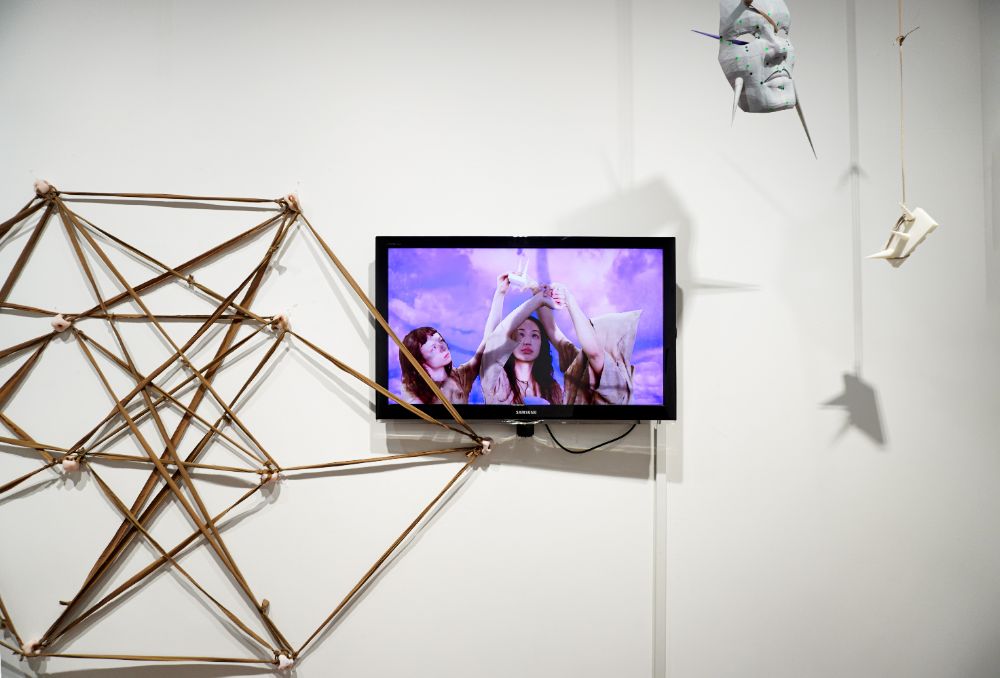
Sylbee Kim explores the obsessive pursuit of ideals like eternal life, wealth, and power in our current age, drawing a poignant parallel with the religious fervor of archaic civilizations and beliefs. In her work Trinity: Finance-Credo-Spirituality (2019), installed on the first floor, Kim draws on the frenzy and unquestioning faith around cryptocurrency speculation that was rampant in 2018, borne from the intersection of blockchain technology and financial capitalism. The artist began this work by observing the societal landscape of South Korea, where there was a collective outpouring of desire to create wealth surpassing that of previous generations.
In the first chapter of the work, the protagonist, who owns nothing but herself and faces an insecure future, wears the Spiny Nodes (2019), which symbolizes neural network for deep learning, and reflects their exposure to the temptations of speculation. In the second chapter, a character, resembling a monk, agitator, and rapper, carries Spiny Device (2019) while preaching about a future promised by technology and a network built on trust and credit. The character in the final chapter prays calmly yet with conviction, asking for an oracle. These characters, each displaying their own beliefs or desires, suggest that, throughout time and across eras, humans are inevitably beings who rely on something in order to overcome uncertainty.
In the final scene, the characters repeatedly intertwine and release their arms together, then ascend gracefully into the air, holding hands. Although they are three individuals, they merge into one unified body, appearing serene yet slightly bewildered, creating an atmosphere of reciprocal forgiveness for the human deficiencies and desires that transcend time and space.
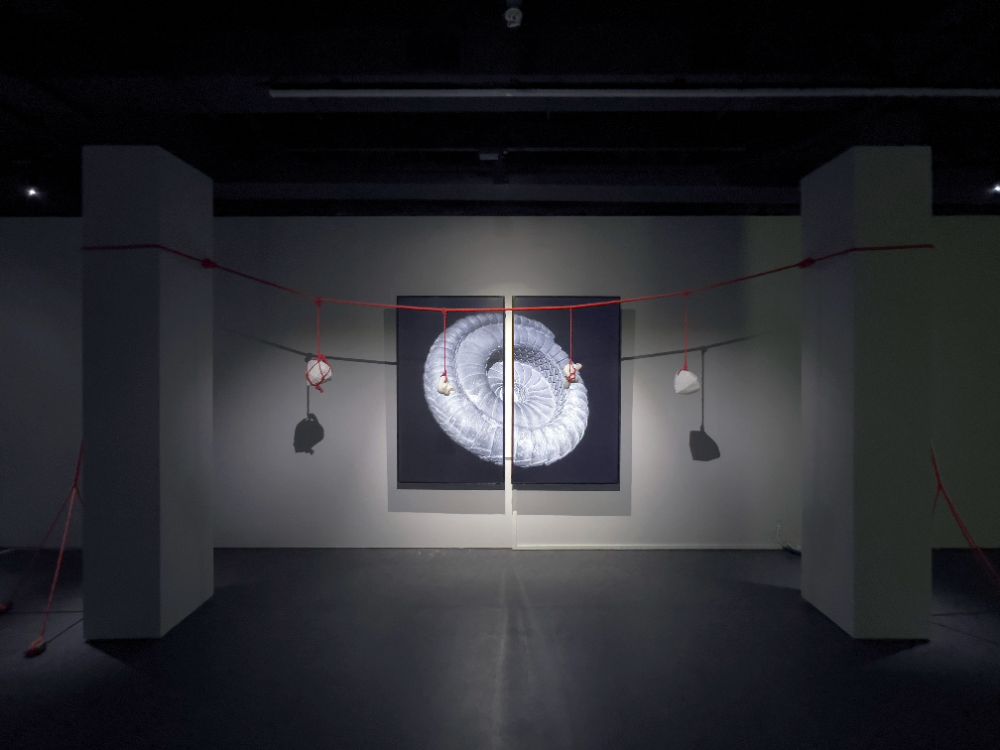
Meanwhile, in Garden of Regrets (2018), Kim questions the motivations behind human faith and choice. This work centers on the Biblical story of the serpent’s temptation, luring humans to break the taboo of Eden (an ideal world), and be expelled from the garden. The title ‘regret’ captures the feeling caused by an event unfulfilled in the past that either seems to be achievable in the future. Where in-between the past, the present and future does the sense of regret arise from? In the Garden of Eden, human desire, sparked by the invitation that eating the apple would make them like God, is the root of this regret. This is also apparent in Kim’s Apple of Your Eye, diamond-shaped objects with serpent’s skin. The pieces Apple of Your Eye 1 & 2 and Study of Coiling Movement 1 & 2 (2018/2024), bound by red ropes in the exhibition space, observe critically yet with empathy the human nature that cannot let go of its inherent desires. Kim’s work does not easily suggest a path to salvation; rather, it portrays evolving histories, spiralling between restorative and reflective nostalgia, through the depiction of humanity and society amid desire, frustration, regret, and reflection.
Yaloo’s work moves beyond the contemporary era to the future realm, observing the endless conflicts and discord within human groups driven by desire and selfishness. Yaloo’s work stems from the phenomena witnessed during the COVID-19 pandemic in 2020, a time when civilization seemed to have reached its peak. She observed the uncontrollable spread of conspiracy theories, racial hatred, persistent discord within communities, and human selfishness, leading her to the realization that humanity can no longer exist as a harmless entity on this planet. This realization prompted her to imagine a future world where a new species, Homo paulinella, lives as harmless beings. On the first floor of the exhibition, there is a science fiction short story titled Slippery, Slimy by the writer Kim Ye-hoon, inspired by Yaloo’s Homo paulinella.
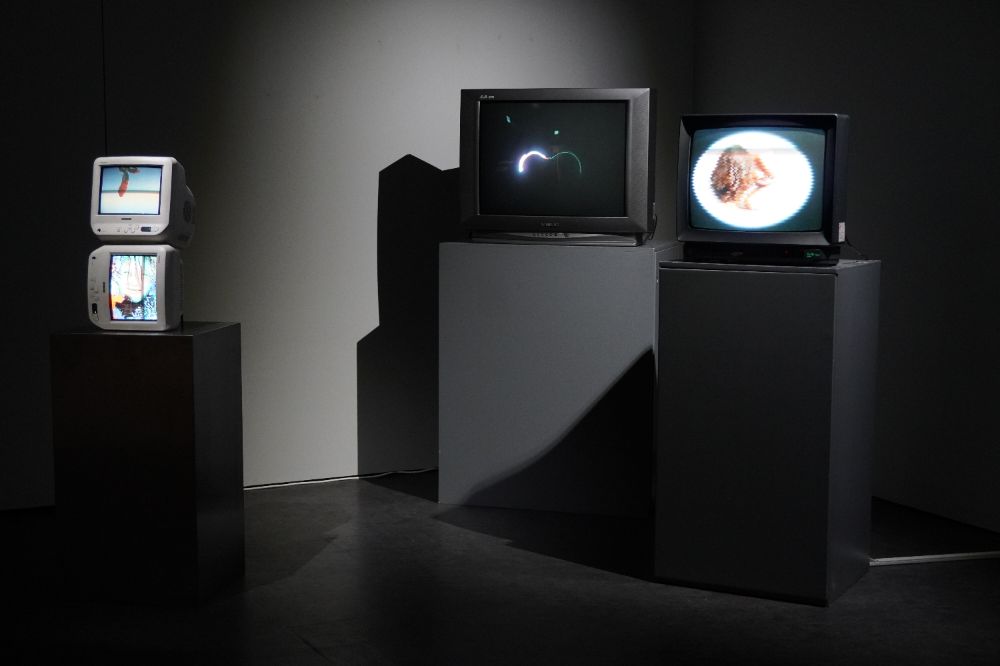
In the ground floor, Yaloo’s video works Homo paulinella the Lab – Don't You Cry Zarathustra and Homo paulinella the Lab – Elements 001 (2020), which explore the ecology of Homo paulinella, are on display.[1] Hounyeh Kim’s Slippery, Moist depicts the extinction of Homo sapiens (modern humans) through a voluntary process, leading to the birth of the new species Homo paulinella through genetic engineering and seaweed. In the story, the protagonist, a grandmother who is Homo sapiens, looks at her daughter and granddaughter, who are Homo paulinella, and says, “I thought they were truly beautiful beings. Unlike me, who had to struggle to survive, they are a species that needs nothing external, loving, progressive, full of vitality, and young... I am truly glad you are not us. Be happy and prosper. With a heart full of blessings, the last Zarathustra now wishes to exit history like this.” (p.104) This text shows that Yaloo’s Homo paulinella series is not dominated by a nostalgic regret for extinction but rather portrays a forward-looking nostalgia, hoping for humanity to coexist anew with other beings. This is not a vague optimism, but a future-oriented nostalgia grounded in ethical and progressive thinking.
The future-oriented nostalgia, which views today’s decline as a gateway to tomorrow rather than an end, is also evident in Han Uri’s work. As a digital native, Han Uri was captivated by the analog projector, an object from the past that had been lost, and began collecting related parts and learning the necessary skills over a period of about ten years. While Han Uri’s obsession with non-existent objects may initially evoke restorative nostalgia, for her, the materiality of the projector holds more significance as a new media, rather than merely as a means of restoring a past medium. Therefore, her work reveals a new and unfamiliar story of the machine through the projector, elevating the existence of the projector, once confined to past time, into the time of the present and future.[2]
Han Uri’s Bertinker (2022) imbues objects with a sense of time, based on stories discovered and woven through the projector. Bertinker fabricates a myth about the Musca constellation, one of the constellations marked on the celestial map created by the 17th-century German celestial cartographer Johann Bayer. In the myth, Musca was once a fairy named Bertinker, who connected distant objects and places with transparent threads, conveying the beautiful stories of the world. However, when humans, seeing this as a money-making opportunity, stole Bertinker’s threads and tried to replicate her magic, they failed. The threadless Bertinker had to live as a fugitive, and in pity, the gods transformed her into a black insect, the fly, and placed her in the sky as the Musca constellation. Han Uri, who interacted with many people who shared her deep affection for projectors, came to realize that certain objects carry meaningful memories and time along with their functional roles. In other words, objects act as mediators or connectors, carrying invisible time. This role aligns with Bertinker’s role in the myth, creating relationships and reflecting the value of existence.
This work of reconnecting once disconnected spaces and times is, in fact, further intensified through the medium of video. Han Uri’s Thin and Deep (2022) is an example of this. This work was created using damaged film that was accidentally exposed to light during filming. Thus, the video in Thin and Deep is filled with the traces of light that passed through the surface of the actual film, manifesting as forms of time on the screen. The delicate yet powerful images of light vibrating on the screen and the fragments of time that appear between these light forms—such as light filtering through trees, colors created by light, 3D sketches of projector components, and cosmic landscapes—alternate in sequence. The images floating in and out of the frame repeatedly appear and disappear, drawing the viewer's gaze beyond the image to an invisible world, like a doorway leading to the contemplation and awareness of what lies beyond the visible.
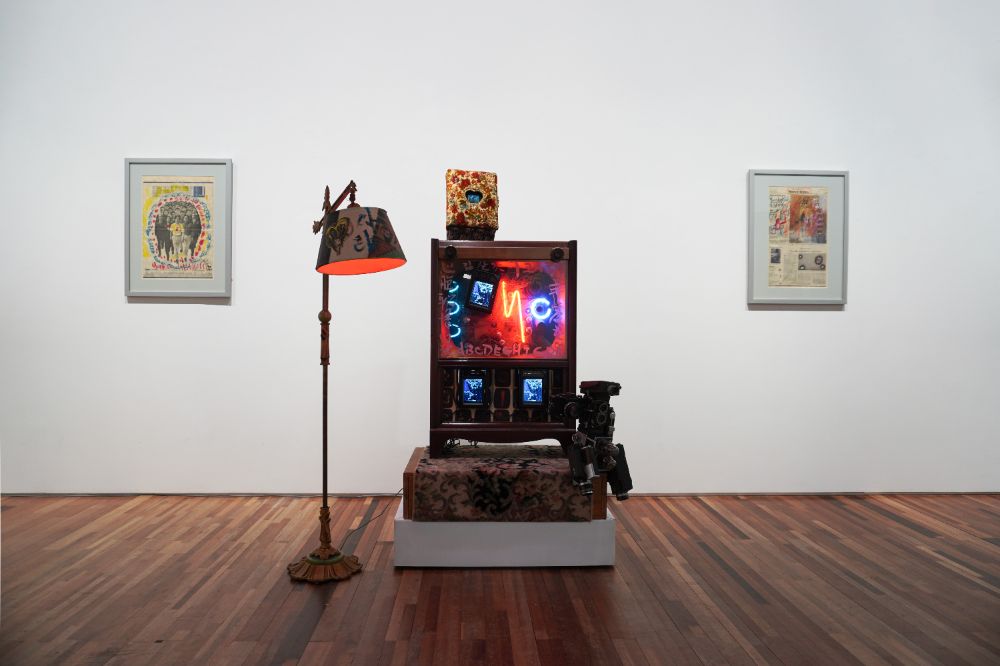
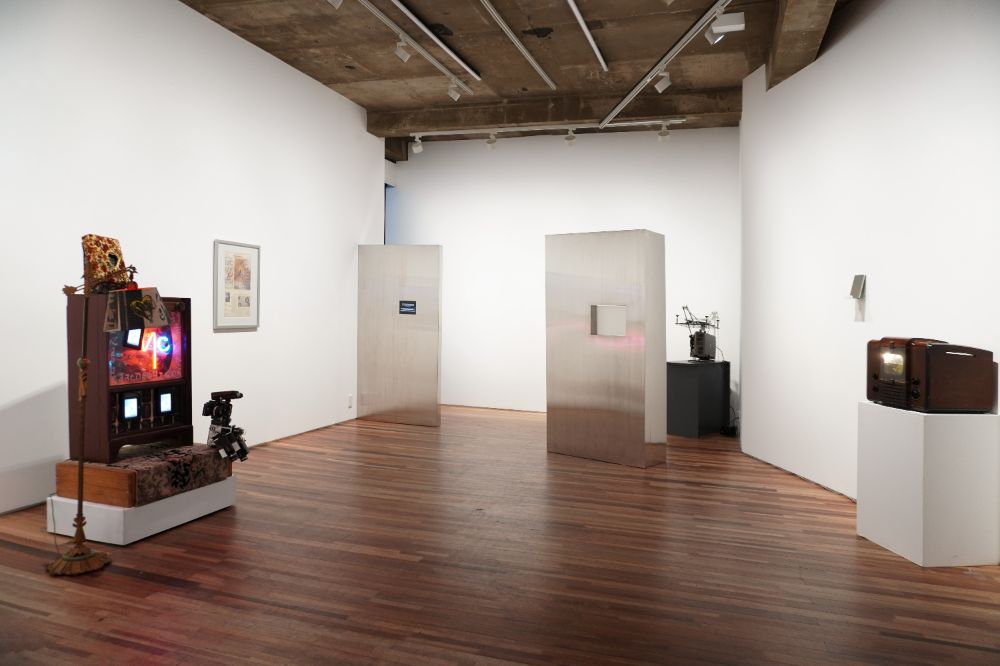
The non-linearity and multi-layers of time, commonly found in the works of the artists mentioned above, is also a prominent feature of Nam June Paik’s Nostalgia is an Extended Feedback (1991), installed on the first floor. This work harmonizes objects with opposing attributes and temporalities, such as old and new, past and future, analog and digital.
The Nostalgia is an Extended Feedback shows how objects with temporalities come together in harmony. This work, which combines old and new items that might be found in a corner of a house, evokes a sense of nostalgia for “home, hometown, longing.” The cabinet and lamp on the carpet and the velvet-covered book evoke a warm feeling associated with antiques, reinforcing a sense of retrospection. However, the neon signs, wires visible through the cabinet window, the robot assembled from various film cameras, and the media images embedded in the objects evoke a mysterious and futuristic atmosphere regarding unfamiliar objects. Paik’s method of reappropriating the past as a catalyst for imagination about the present and future stands out. In this work, each object clearly contrasts when viewed from the perspectives of past and future, but they are visually perfectly natural. The harmony generated in Paik’s work shows that the past and future cannot be separated and exist most beautifully when they resonate with each other. Like Paik’s work, Sylbee Kim, Yaloo, and Han Uri integrate, arrange, and synthesize objects from the past, present, and future, expressing their unique perceptions and views on contemporary times through art, based on a philosophy of time.
Written by Sohee Lim (BHAK Curator)
[1] Homo paulinella possesses advanced intelligence, is capable of photosynthesis, and has perfectly balanced the production and consumption of oxygen and carbon dioxide within its body, making food intake and respiration unnecessary. These beings long for affection and primarily engage in artistic creation using scientific equipment, existing as future humans who love nature and coexist with all beings, having removed negative elements such as hatred, fear, and aggression.
[2] The Sonatine for a Gold Fish by Nam June Paik, installed next to the book, metaphorically represents the coexistence of technology and nature or the trajectory of nature as technology, through the visual disorientation of a monitor becoming an aquarium and an aquarium becoming a monitor. The monitor-like face in the drawing installed on the first floor symbolizes the human self-portrait in the information age and the future human, as seen by Paik at the time, with an antenna on its head, reaching a state of ecstasy. Finally, in the basement, Horizontal Egg Roll TV shows a woman curled up like a fetus inside an egg on a TV screen, symbolizing the principle of creation and destruction in Eastern reincarnation philosophy, reminding us of the cycle of life, while TV Crown visualizes the cyclical nature of life and infinite temporality in the same context.