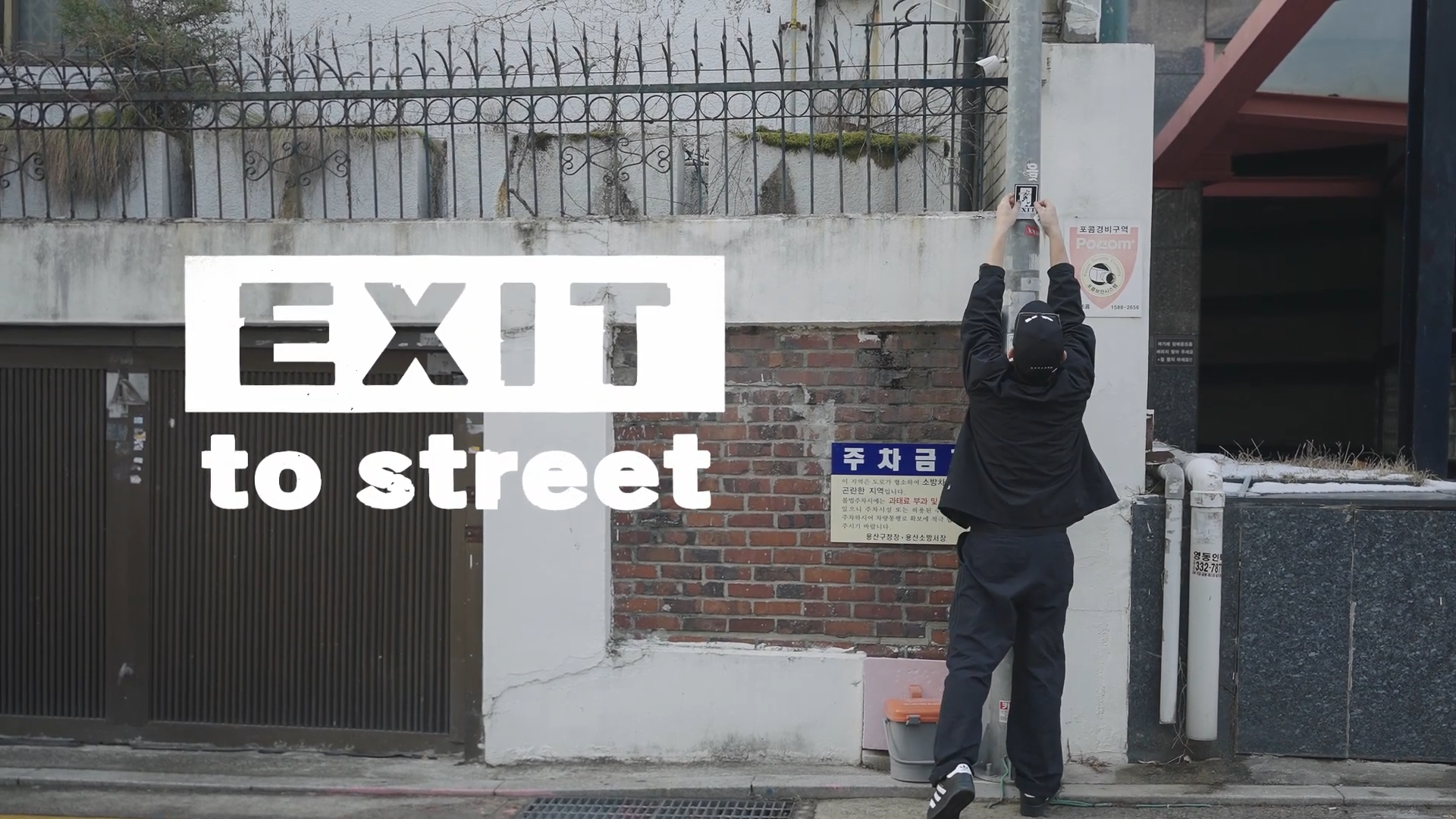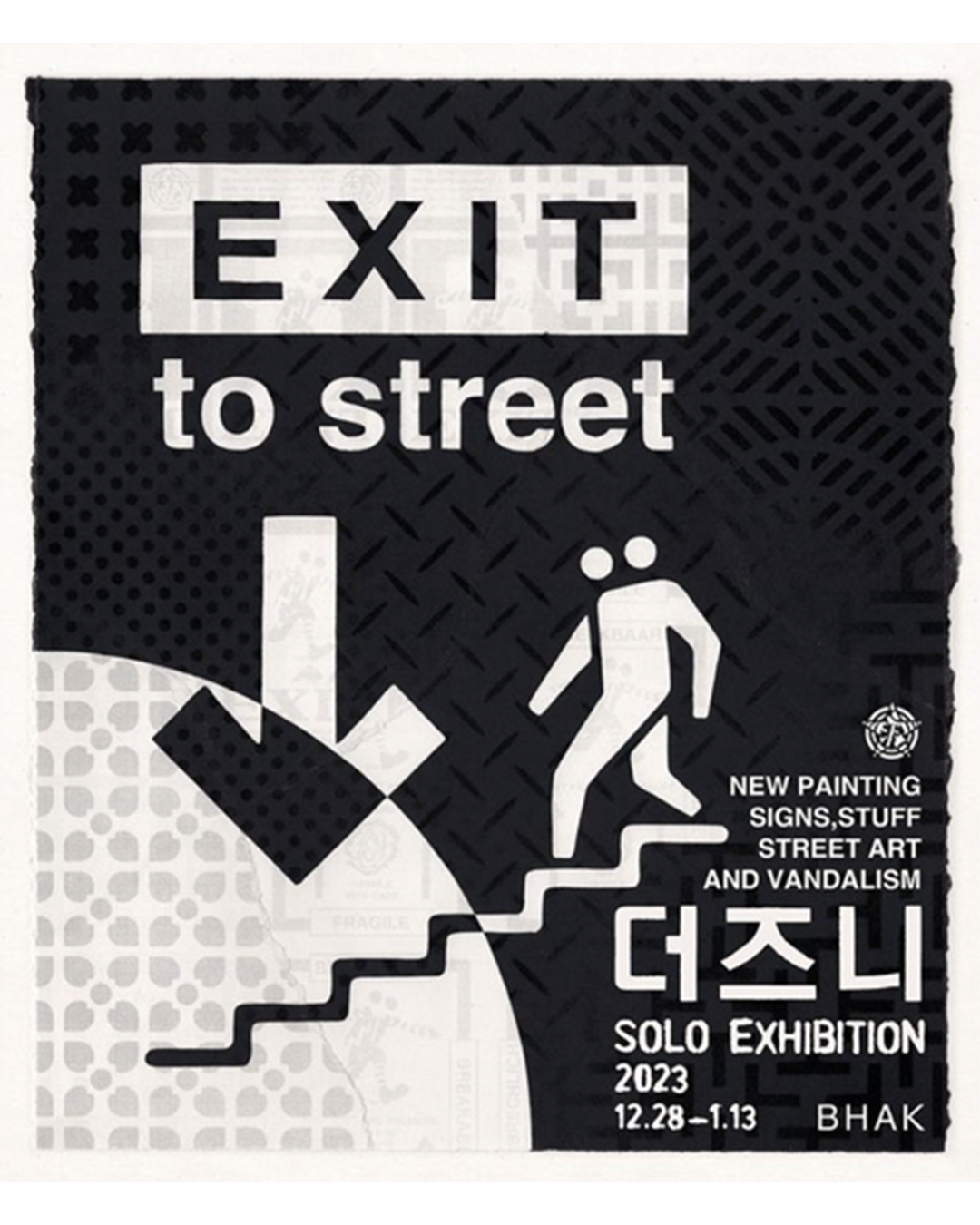
Doezny (b.1992) engages in artistic activities using the walls of the streets as canvases. The title of the ex-hibition indicates that Doezny's primary stage is the street. In this exhibition, installations transforming street objects and flat works attempted on the walls of the street are brought into the indoor exhibition space.
Doezny's artistic style is based on the forms and spirits of Street Art, which emerged in the 1970s-90s in the United States and France, showing a modified form adapted to contemporary situations. Streets are spaces where diverse individuals pass and gather, sharing not only individual but also collective emotions. Streets and squares have long served as platforms where citi-zens' voices and political discourse unfold. Inviting diverse people and fostering the exchange of thoughts and emotions in the space of the street, artists use the street as a canvas to showcase their art.
However, their creative acts, taking place not in private but in public spaces, can evoke discomfort. The artists appear on the streets during less crowded times, marking his art and disappearing. Yet, this discomfort is fundamentally a means of persua-sion that street artists aim for because their works are not records or reproductions but actions that trigger events. Doezny's work, exposed in the open street accessible to everyone, allows for immediate awareness and sensory experiences in unpre-dictable situations, shared not just in the personal realm but in the public domain of senses and emotions.
In the case of Doezny, he generates layers of meaning related to the theme of 'freedom' and 'liberation' through familiar im-ages and simple phrases in everyday life. The character 'Ronald' plays a central role in his works, representing the mascot of the famous fast-food chain, McDonald's. Doezny portrays Ronald running unreservedly towards something, symbolizing a state of freedom. Behind this portrayal lies various aspects, from the street artist's situation of drawing and quickly leaving the scene on the street to the artist's autobiographical stories and societal phenomena.
On a personal level, Doezny, a former athlete, found it challenging to adapt to the static and performative nature of the do-mestic art education system when transitioning from sports to art. Choosing not to conform to academic education, he em-braced an active approach to creativity, leading to his current involvement in street art. He associates the courageous judg-ment and choice to come out to the street to freely express his thoughts with the phrase 'Exit' and says that the liberated moment is the entrance leading to 'freedom.'
Doezny's work goes beyond personal narratives to address societal inequalities. His art criticizes issues of inequality related to wealth disparity, racial discrimination, and prejudice against people with disabilities, drawing from his own experiences during childhood and encounters in social life. Doezny emphasizes the importance of reducing discrimination and valuing individual efforts and capabilities in modern society. He advocates for a society that blocks unfair oppression, considers the socially vul-nerable, and respects individual opinions and possibilities.
The themes of inequality and the value of freedom are presented in the form of a pictogram combining the figures of both genders in Ronald's appearance. Ronald, with two heads, represents an anonymous existence where it is impossible to distin-guish between male or female, rich or poor. This depiction symbolizes a state of freedom, conveying messages of warning and hope alongside warning statements and star-shaped symbols.
Doezny's work does not have the ultimate purpose of reproducing a particular subject or conveying a literary narrative. His art exists as an event revealing facets of the era and society that are closely intertwined with his life, expressed dynamically. In this regard, the exhibition title "Exit to street" does not simply mean an exit to the external in a physical and one-dimensional sense. Doezny's art allows us to experience an art where the boundaries between the exhibition space and the space of life events are blurred, providing each individual with time to reexamine the footsteps they carve anew every day.