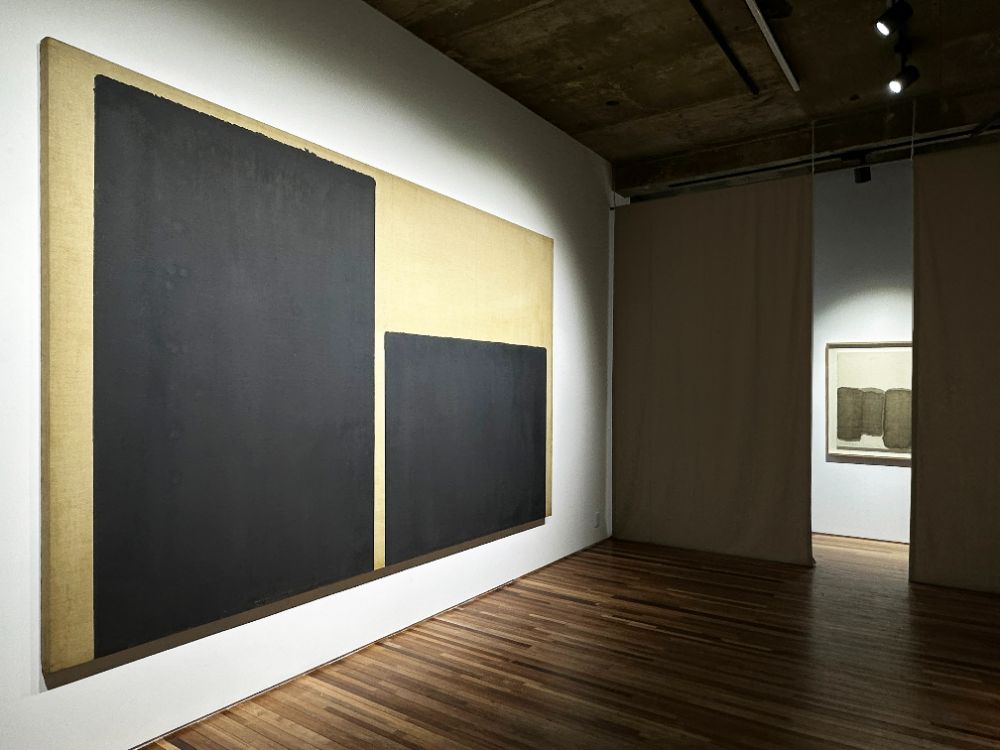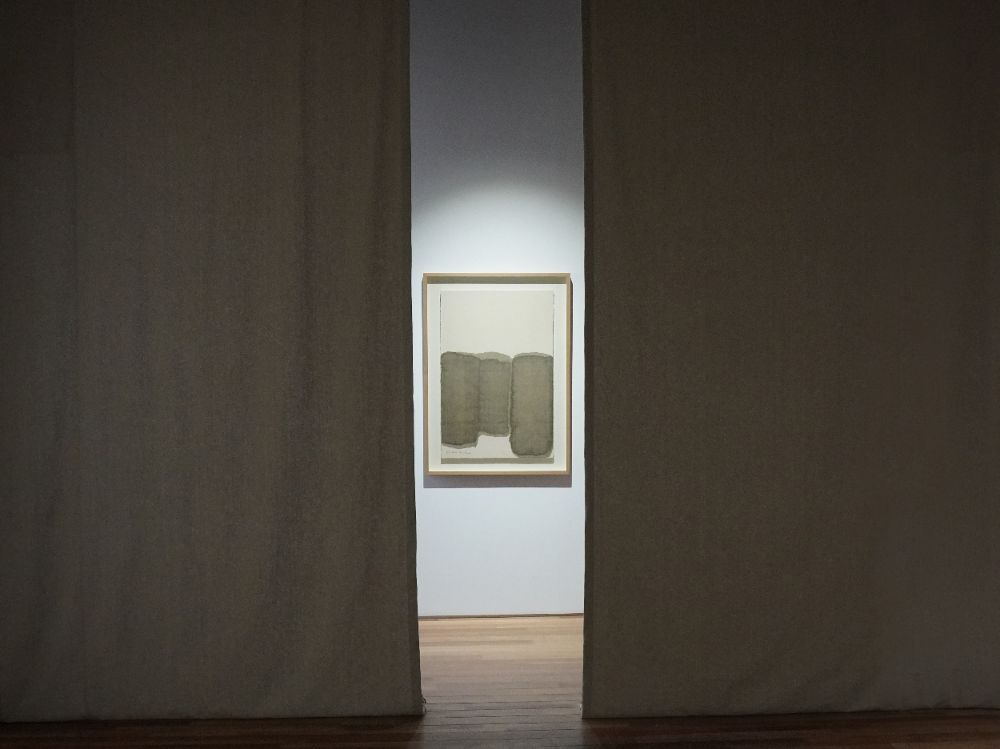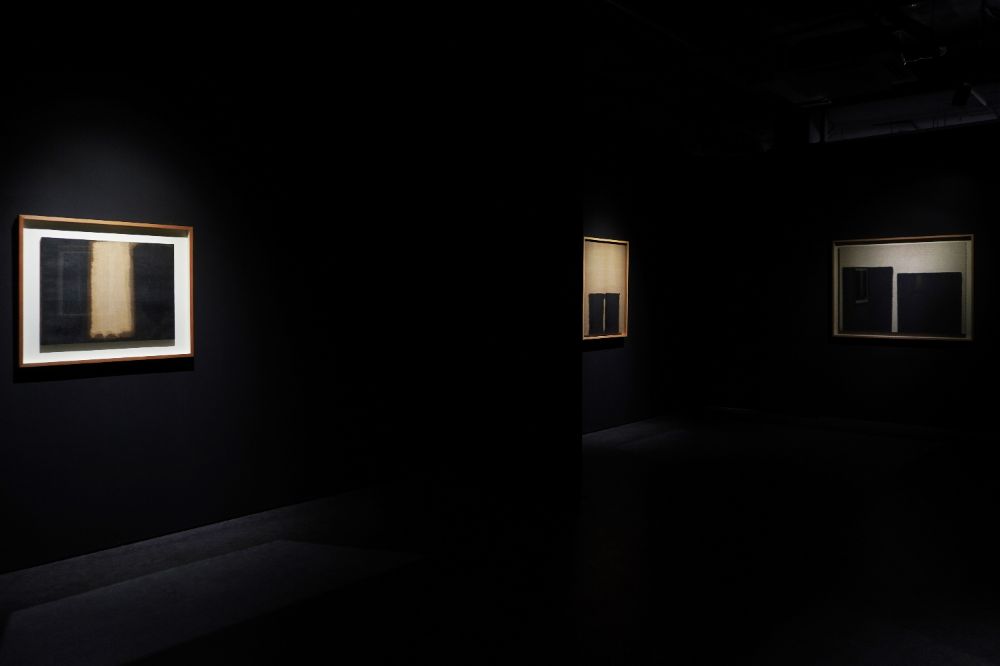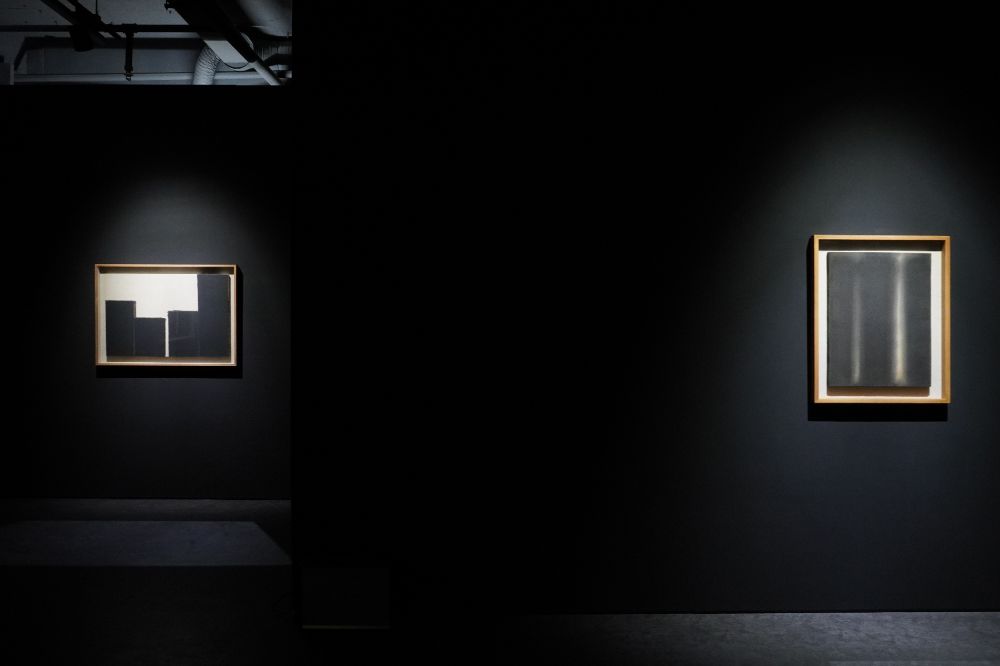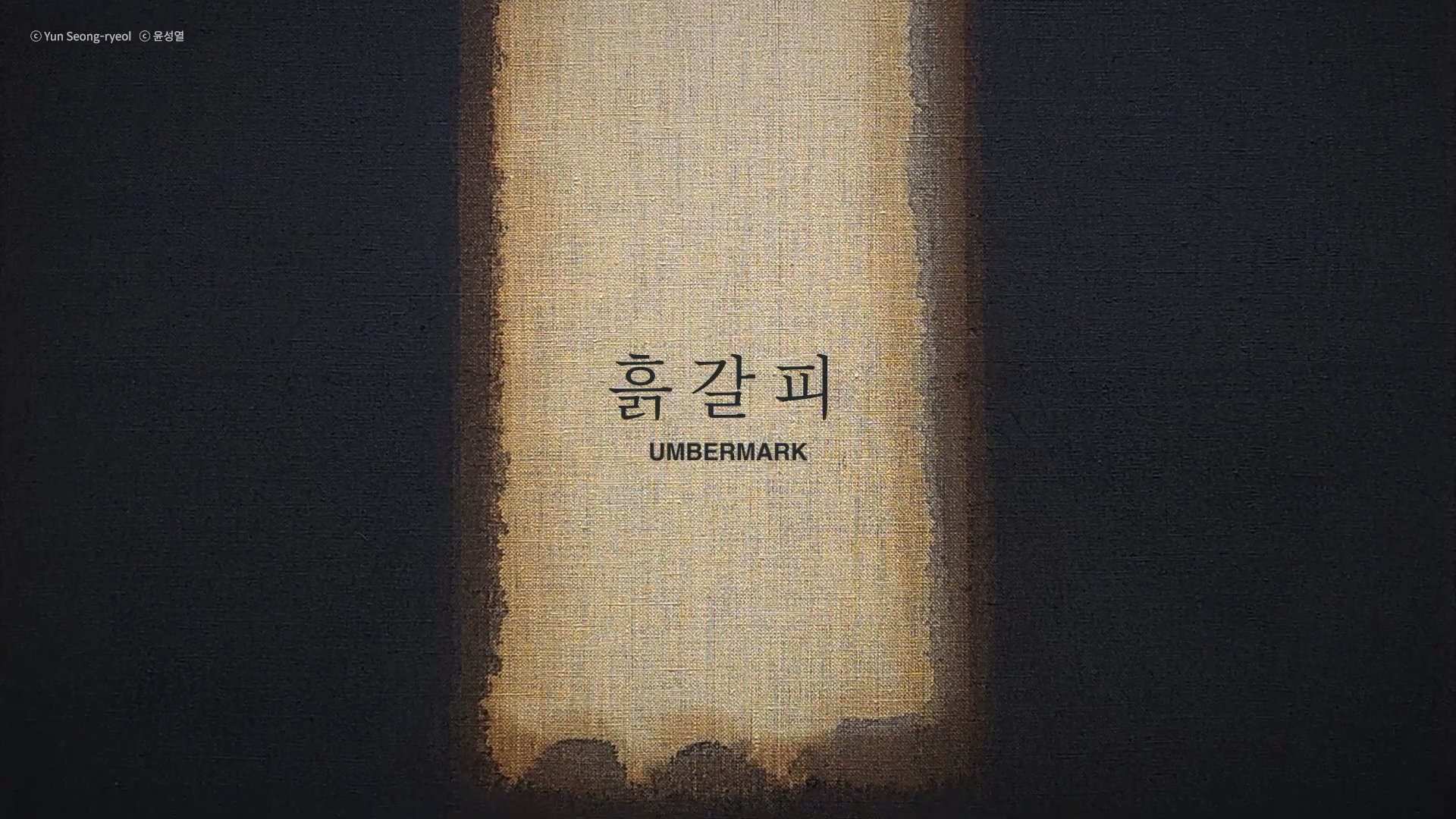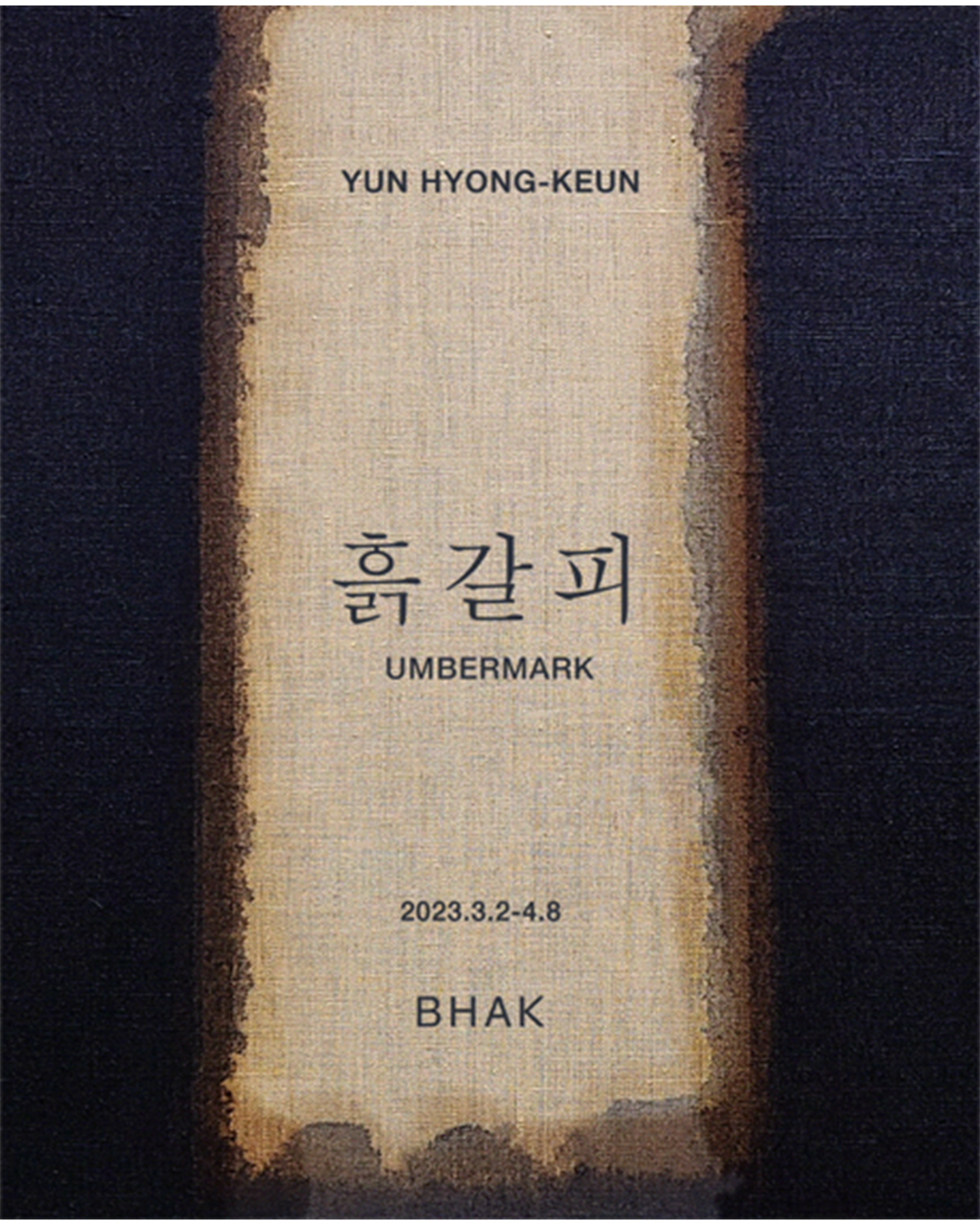
Yun Hyong-keun’s painting does not recreate or decorate a subject. It simply seems like a trace of soaked brush stroked across the canvas. The indistinguishable yet distinguishable brush strokes are the result of Yun’s repetition of applying and drying paint mixed with terebene or linseed oil.
Yun’s style of artwork can be explained in three ways. First is the abstract surface of the early 70s. Then there is the style of “gate of heaven and earth” in the 70-80s, where two or three streaks of lines are bled into the canvas differently according to the concentration of the paint. Finally, he diminished the bleeding of the pillars and layered more paint until it reached black in the 90s.
Yun’s consistent figurative language became an important visual element that not only represents the artist’s unique style of technique but also implies the artist’s life
Like other artists, Yun also painted his reality onto the canvas.
Yun (1928-2007) was born in Cheongju, North Chungcheong Province, and spent his youth in tumultuous times of modern Korea, going through the Japanese colonial era and the Korean War.
He studied at Seoul National University in 1947 but was expelled after imprisonment for being part of the student movement.
After the outbreak of the Korean War in 1950, he was almost executed by the broadcasting association because he was part of a protest when he was a student. In 1956, he served six months in Seodaemun Prison because he was unable to flee and was forced to work for the North Korean Army during the war. In 1973, while he was teaching at Sookmyung Girls’ High School, he was arrested for violating the Anti-Communist Act because he raised the issue of the illicit admission of a student, which was supported by the head of the Central Intelligence Agency.
Serving several terms in prison and having his life on the verge of death led Yun to express his angst on the canvas.
“After I left the prison, I got rid of all the paintings and was determined. This is why my paintings changed since 1973.
At first, it was painted in primary color but it became black the more I layered it, I wanted it to be pitch black, so I mixed ultramarine and burnt umber with water and painted it dark.”
“There may be a void of youth in my art.
The biggest problem was running away, being chased, and surviving in fear and anxiety.”
"My paintings are far from colorful.
The point in life is to live in the right direction.
My art implies such experience.
Just like how people go through changes in emotions from their experiences as they age, I believe my paintings change like so.
That’s why paintings can be seen as a trace of life’s experience." (2003)
Yun used yellow hemp cloth as a base instead of white canvas, and painted umber and ultramarine-blue on the cloth, naming them the colors of the earth and heaven. He placed the cloth on the floor of his studio and repeatedly layered paint from top to bottom as if he were releasing his angst. The wet brushstrokes from his painting are like a painful cry, the haziness is like his weeping, and the black strokes that fill the canvas are like the silence after liberating from the agony.
The traces of Yun Hyong-keun’s brushstrokes show the traces of his life. He resisted the difficult reality through his paintings and mourned his pain and sorrow. He was able to overcome such hardships by keeping himself close to nature.
“It was fifteen or sixteen years ago. I climbed Mount Odaesan.
The deciduous mountain was a dreary sight.
I found a giant tree rotting away across the hill.
I stood there for a long time captivated by how the root turned into the soil. The sublimity of nature.
That was when I was inspired by the mystery and provision of nature.” (1986)
Yun Hyong-keun experienced the mysteriousness and spiritual enlightenment of nature by witnessing the natural order of rooted trees returning to the earth. He implemented this natural order to build his life and art.
Yun Hyong-keun mentioned that he wanted his paintings to blend into the earth. The works from the 90s deliver the core message of his art returning to earth.
“Although my paintings are humble, I want to hang them
on a dirt wall.
I want to create something that is harmonized with the dirt wall.
No matter how long time goes by, the beauty of earth, trees, and stones will last forever.” (1990)
In Yun Hyong-keun’s later work, the flame-like pillars simmered down on the canvas. The brushstrokes filled with anger and the composition of gates of heaven and earth died down. He was left with refined black pillars on the hemp cloth. The naturally seeped black pillars blurred the boundary between heaven and earth. The paint and canvas became one like a serene horizon.
Like the tree from Mount Odaesan returning to the soil after death, Yun Hyong-keun’s later works are left with divinity after transcending impurities like agony and sadness. Such formative language is the result of depicting the final stage of his life.
Yun Hyong-keun’s paintings enter the realm of earth that gives the final impression of a beginning and an end, a birth, and a death.
Yun Hyong-keun mentioned “I paint a sharp cry without any small talk” while Kim Whanki’s paintings are “poetic and delicate”. Hence, it can be implied that Yun’s life and art are rooted in the ground rather than the sky.
To Yun, the earth was physically and mentally in multiple locations. First, the earth can be the ground where he can set his foot but also symbolize the unexpected encounter with death. Earth is also the symbol of a realm where everything returns back to and implies death in the future. Lastly, it symbolizes the beauty of nature and its resemblance to Yun Hyong-keun’s nature-like paintings. Hence, the name of the exhibition, Umbermark, connotes not only the physical traces of land but also the traces of Yun Hyong-keun’s life and art.
What on earth is a painting? I have yet to find the answers.
It may be something of a vestige for my consumed life.
(Excerpt from A Stray Thought at a Studio)
Yun Hyong-keun is a man who came back to life on verge of unexpected death. He began to express himself through art in his prolonged life and thus his theme of art cannot be apart from death that existed in the past and will face in the future. Yun Hyong-keun’s paintings confront the agony lurking behind life, accept it as a way of nature, and sublimate it into the beauty of nature. Therefore, his paintings never remain in sorrow. Instead, it touches and comforts the viewer’s grieving heart. Yun Hyong-keun’s painting is the art of sublimation that allows viewers to experience the beauty of joy and pleasure rather than eternal sadness.
When we get emotional, it’s because we’re feeling all emotions at once: joy, sorrow, grief, and happiness.
Sorrow is the inverse of joy. In other words, the ultimate beauty is joy and sorrow, simultaneously.
That’s why art-especially the most beautiful art – is always sad.
Maybe that’s why our saddest moments and happiest moments both bring tears to our eyes. (1980)
Written by Sohee Lim
Translated by Hyewon Kwon