Spanish painter Salustiano García Cruz (Seville, 1965) answers simply by his first name, ridding his persona of surname,artifice, complement or accessory: the same intention he applies to the creative process.
“I think of the idea I want to present and look for the way to remove all accessories. Better if I can express it with the minimum elements possible, almost like pruning unnecessary branches. I then try to materialize it with respect and affection,” says the artist from a cabin near Yosemite National Park, where he is painting for his next exhibition. Salustiano studied fine arts at the Universidad de Sevilla. His meteoric career spans the globe, with solo exhibitions and group shows in Germany, China, Chile, USA, Spain, Japan, Russia, Korea and Switzerland. He is also a regular at the world’s most prestigious art fairs like ARCO and Art Miami, or the international art fairs in Moscow, Tokyo, Frankfurt and Shanghai, among others. He admires Hockney, Holbein and Francis Bacon, but his inspiration comes from his own experiences.
“Everything influences me. The art I see and the life I live”. He is especially attracted to the little things: “sunlight, the smell of wet earth and poppies, shadows, the endless green of a small blade of grass, the perfect mechanism of the legs of an almost translucent spider, the eve of holidays, quince jelly.”
Salustiano shares his life with Andalusian sculptress Ángela Lergo and their young son. Since his first exhibition, Hombre del Futuro (1994), at the Museo Provincial de Huelva, his intimate, poetic oeuvre has captivated the attention of both critics and collectors.
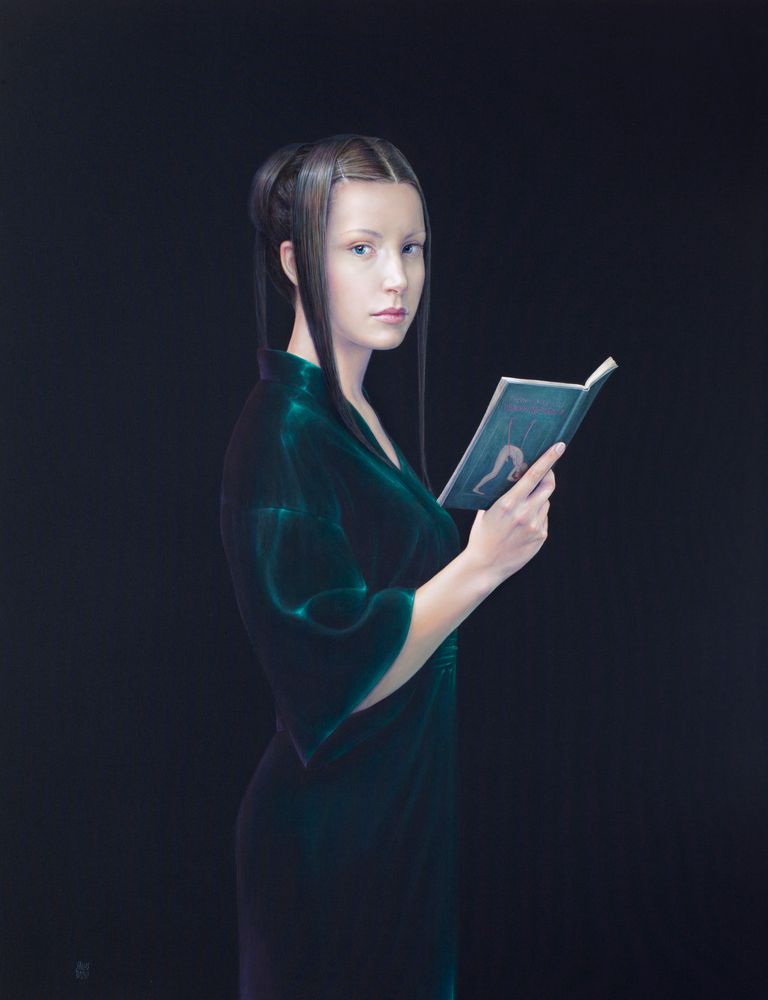
Fine, realistic paintings armed with humanistic eloquence, his works dither between renaissance portraiture and Eastern sensibility, surrounded by the postmodern context that possesses it. His pieces exude a refined spirituality that digs deeply into the viewer’s consciousness. Salustiano plays with irony and humor through lyrical contemplation, denying any religious preference.
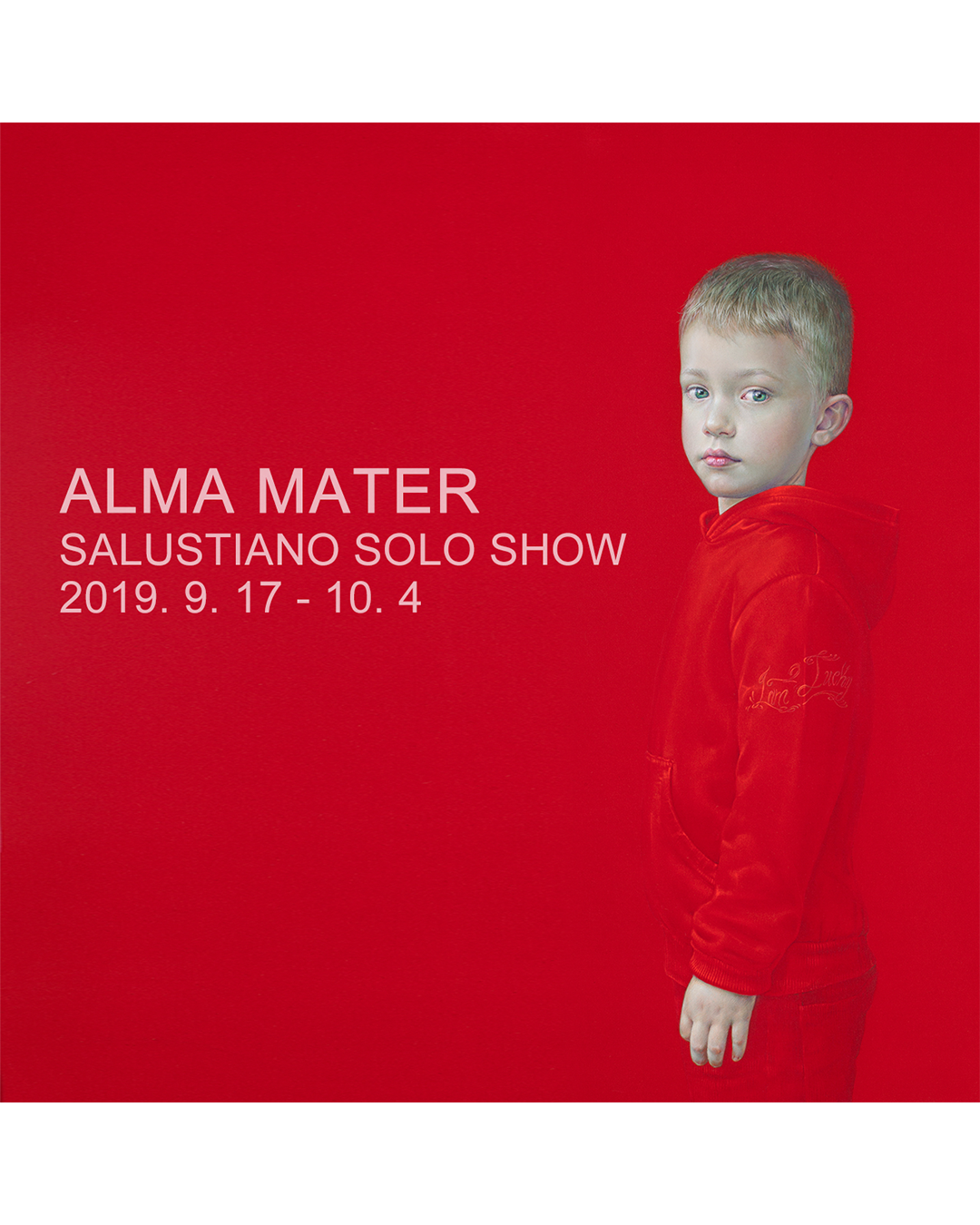
The backgrounds of his paintings are blood red. Not only because red is a stimulating poetic proposition, but because, like blood, his work penetrates the viewer in a visceral way. “Red is a color filled with connotations and intentions. It provokes feelings of beauty, of the absolute, of absence of time, of calm, and at the same time it is an expression of force; it is the color of blood, of religion and of the chosen ones. Red has the power to transcend its own condition of color to become a symbol”.
Recently, black has begun to replace red in his paintings. Once more, it is a way of getting closer to the absolute. It is difficult to withdraw from the defiant gaze of the models when confronting the work of Salustiano. On the contrary, the viewer clings to the image as he would to an amulet, a source of peace, harmony and balance. His work can be disturbing and beautiful but refrains from specific themes. Its only intention is to capture the viewer and provide a moment of beauty and serenity. “I aim to inspire a particular state of mind, always pursuing an emotional purpose. In that sense, my pieces work very much like music or abstract painting”.
He resorts to anonymous models for his paintings, people he meets in the street. “They are not necessarily beautiful, but I sense they can help me convey a particular emotion. Later I’ve discovered that, in every case, those people were very special individuals, and strangely enough, many of them were related to music.” Most of the time, he uses young types to get close to the animal spirituality we all possess and lose over time. But he has painted people of all ages, including his young son, who is “extremely beautiful, in the same manner angels, archangels and cherubs are beautiful,” as Salustiano describes his first-born.
According to the painter, the human figure is the best vehicle to convey emotions. The gender of his models is not important; it’s almost ambiguous. The right attitude, an intention laden with emotion, suffices to make the painting shine with humanistic sparkle and controlled lyricism. “I try to establish with the viewer the same relationship a film director has with the audience. The model (actor) is the messenger.” His work is often informed by a dose of humor and irony, and the absence of a specific theme or a particular narrative is replaced by the intention to inspire lasting emotions. “My paintings are images that don´t try to say ‘something’. Instead, I want to provoke a series of sensations in the viewer. Perhaps not even that, because a sensation can be too evident and transient. I aim for something more primitive, more profound, subtle and enduring.”
Salustiano’s pictorial realism, like photography, captures a moment, a look, a flash. But contrary to photography, his images stay embedded in one´s memory as something that never was, something that might be, a product of human imagination, moving away from photographic realism for the sake of eternity.
His art is the result of an intellectual process, calculated and refined until it achieves the desired result. “A brilliant idea, if you don´t develop and polish it until it reaches perfection, cannot become a work of art. The works of art that I admire were not the product of spontaneity, divertimento or happenstance. I think of the Cathedral of Cologne, Brahms´s Sonata for Cello and Piano No. 1, or the Madonna of Chancellor Rolin, by Jan Van Eyck“.
He paints what he thinks and not what he feels: “Art must be seen with the eyes of the soul, but should be done with the eyes of the body …a work of art should be created in a laboratory, more than in a psychiatrist´s chair.”
About beauty, he adds: “Oscar Wilde used to say that women were not born to be understood, but to be loved. Well, I think beauty should not be defined, but rather created and admired.”